
Arena Ownership Is the Real NBA Advantage — and Baskonia Already Proved It Works in Europe
By Hoop Britain Research
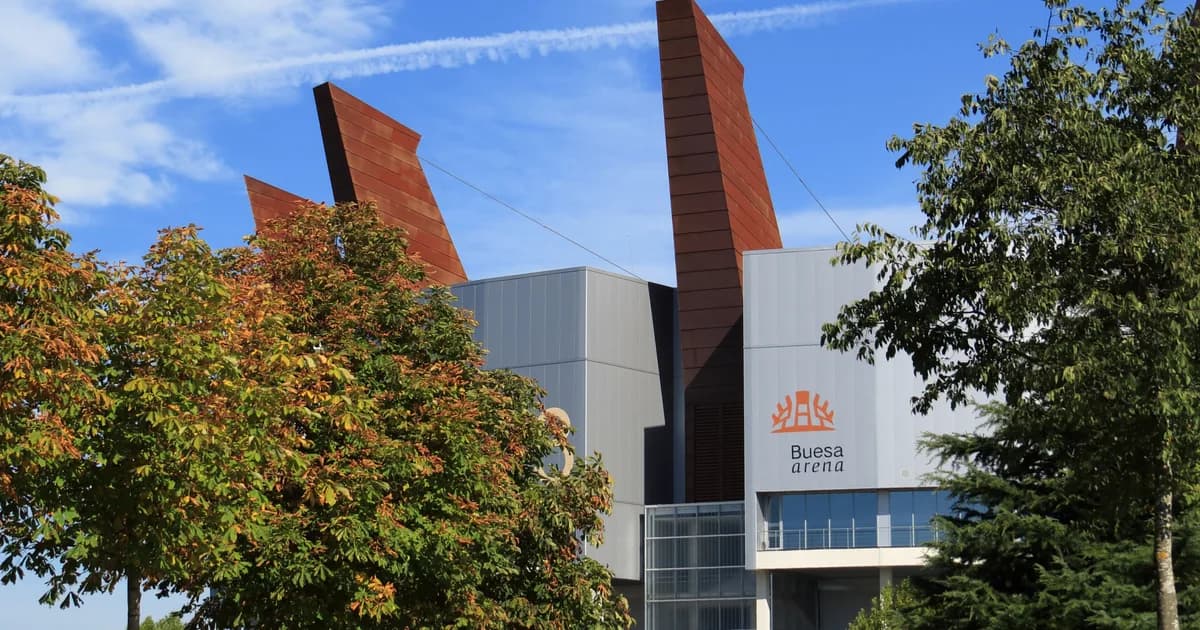
TL;DR: The NBA's biggest local-revenue gaps — naming rights, gate receipts, in-arena hospitality — all trace back to which teams control their building and which merely rent one. In Vitoria-Gasteiz, a Basque city of 255,000, Saski Baskonia has already run this exact playbook at EuroLeague scale: pairing home games with full arena concerts to convert casual entertainment fans into season-ticket holders.
The NBA Pattern: Ownership Compounds
Golden State Warriors' $307 million in gate receipts didn't happen because the team is good — it happened because the Warriors own Chase Center and the surrounding Thrive City mixed-use complex outright, letting them monetize the building 365 days a year, not just on 41 game nights. Compare that to a tenant franchise in a municipal arena, capped at whatever the building's owner allows. That gap — arena naming rights alone run 6-8x higher for owner-operators than tenants — is covered in full in The NBA's 80/20 Rule.
EuroLeague clubs are overwhelmingly tenants. Most play in municipally owned arenas with limited say over concessions, hospitality build-out, or the non-basketball event calendar. Two exceptions prove what changes when that flips.
Baskonia's "Opening Game": Basketball as Festival
Saski Baskonia plays out of the 15,504-seat Fernando Buesa Arena in Vitoria-Gasteiz — a city of just 255,000 people, meaning the arena alone holds roughly 6% of the entire municipal population on a game night. Facing a hard demographic ceiling that basketball purism alone couldn't fill 35 times a season, the club pioneered its "Opening Game" model: pairing a EuroLeague or Liga ACB season-opening fixture with a full-scale arena concert immediately after the final buzzer, using concert-grade production values, drawing casual entertainment fans in from Bilbao, San Sebastián and Pamplona who'd never otherwise buy a basketball ticket.
According to Baskonia's own commercial leadership, more than half of the club's new season-ticket sign-ups in recent seasons trace directly back to fans first walking into Buesa Arena for one of these hybrid game-and-concert events. Baskonia also shares its executive, marketing, legal and ticketing infrastructure with sister football club Deportivo Alavés under the same holding group — a smaller-scale version of the multi-sport cross-subsidy that keeps Real Madrid and Barcelona's basketball sections competitive (see Real Madrid and Barcelona: The Multi-Sport Blueprint).
Žalgiris: The Full Arena-Operator Model
Žalgiris Kaunas goes a step further — its parent group doesn't just host the occasional concert, it runs the entire Žalgirio Arena as a year-round commercial venue: 203 non-basketball events in 2024 alone, drawing 932,300 combined attendees on top of the basketball crowds. Concession margins, hospitality suite income and event rental fees flow directly back into the playing budget, which is why Žalgiris — a club from a city of 305,000 — posted an actual audited operating profit (€1.3 million surplus in 2023-24) while much bigger-market clubs like Real Madrid and Barcelona run structural basketball deficits in the tens of millions. Full detail in How Žalgiris Kaunas Sells Out Every Game in a City of 300,000.
What This Means for NBA Europe's Arena Bet
Every NBA Europe target city is, in effect, being asked to make the same arena-ownership bet the NBA made decades ago and Baskonia and Žalgiris have already made at a fraction of the budget: London's ownership group has priced a purpose-built facility at £350 million to £1 billion specifically because renting an existing arena caps the revenue ceiling permanently. The lesson from Vitoria-Gasteiz and Kaunas is that the payoff doesn't require an NBA-sized building or an NBA-sized budget — it requires control, not scale.
This piece is part of our ongoing NBA Europe vs EuroLeague business playbook. For the fuller list of transferable NBA advantages, see 10 Things the NBA Does Better Than EuroLeague, and for whether small markets like Kaunas and Vitoria-Gasteiz can keep outperforming NBA Europe's big-city targets, read Why Small-Market Clubs Outperform Big Cities in European Basketball.
Sources: 2playbook.com Baskonia commercial interviews, Žalgiris official impact study and budget announcements, Forbes/Sportico NBA franchise revenue data. Accurate as of September 22, 2026.